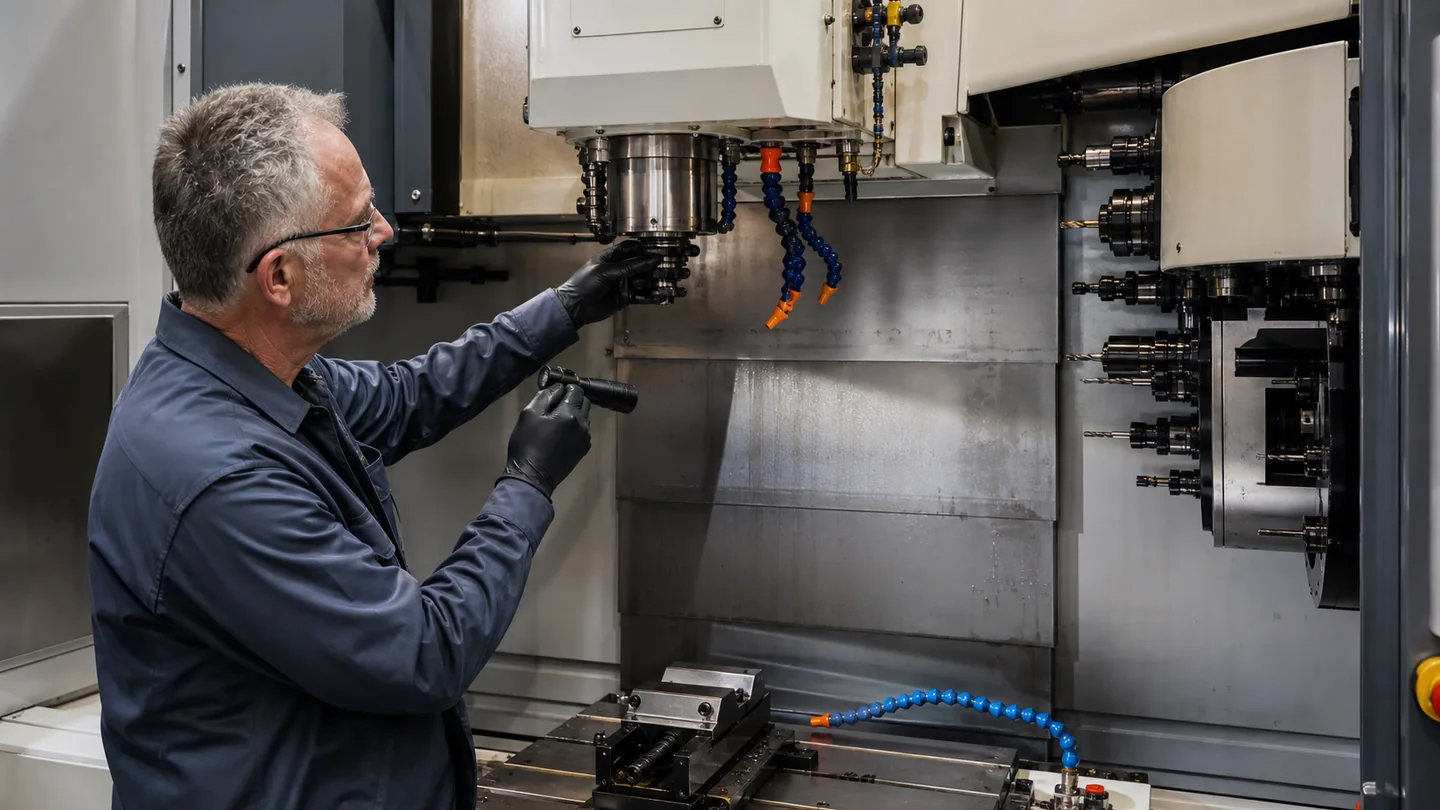
Preventive maintenance for a CNC machining center is a planned set of inspections that keeps lubrication, cooling, air, chip removal, tooling and safety systems within their intended condition. The machine manual remains the controlling document. A useful local checklist turns that manual into named tasks, intervals and records suited to the plant’s workload and environment.
Before any maintenance work
Separate observation from intervention. An operator can record oil level, pressure, leakage, noise or alarm history during normal checks. Work that exposes hazardous motion or electrical, pneumatic, hydraulic or stored energy requires the site’s isolation procedure and trained personnel. The U.S. Occupational Safety and Health Administration’s control of hazardous energy guidance explains the lockout/tagout principle; local law and the machine manual may impose other requirements.
Operator checklist
| Interval | Check | Record when |
|---|---|---|
| At shift start | Lubricant and coolant levels, air supply, visible leaks, guards and alarms | A level changes unexpectedly, pressure is unstable or a guard does not function normally |
| During operation | Spindle sound, vibration, tool-change behavior, chip flow and coolant delivery | The condition differs from the established baseline |
| At shift end | Remove chips from approved areas, clean exposed work surfaces and inspect chip buildup | Chips enter covers, drains or locations that are not clearing normally |
| Weekly planning | Review consumables, filters, concentration records and open maintenance items | A task is overdue or consumption changes without an operating explanation |
The interval labels above are a planning example, not a replacement for the supplied maintenance schedule. A high-duty cast-iron process and a clean, single-shift aluminum process will not create the same chip, filtration or coolant load.
Items for trained maintenance staff
- Inspect the spindle taper and tool holders for contamination, damage and fretting.
- Check tool changer alignment, gripper condition and abnormal change time.
- Review lubrication delivery, metering units, lines and alarm history.
- Inspect filters, fans, heat exchangers and electrical-cabinet seals.
- Check way covers, wipers, chip conveyors and coolant return paths.
- Trend backlash, leveling, spindle condition and geometry at the manual’s specified intervals.
Use trends instead of a box-ticking sheet
A check marked “normal” is difficult to investigate later. Record the observed pressure, concentration, consumption, alarm code or condition where the task calls for it. Trends can reveal a restricted line, a developing leak or a changing spindle condition before a single reading crosses an alarm threshold.
Keep photographs and service reports with the machine record, and note what changed after a repair. If the same symptom returns, the history prevents the team from repeating the first diagnosis without evidence.
Build the final schedule around the machine
Start with the model-specific manual, then adjust task ownership for shift pattern, material, coolant, humidity, dust and automation. Do not lengthen a manufacturer interval without engineering approval. When requesting support, include the machine model, serial number, operating hours, alarm history, recent maintenance and photographs of the condition. For model-specific documentation or parts support, use the CNC Tech contact page.