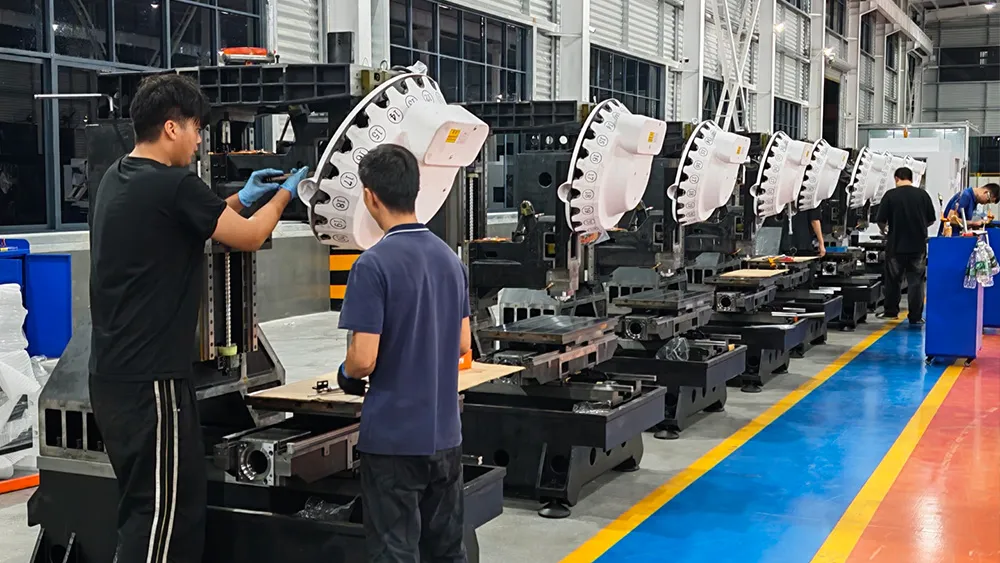
CNC machining centers combine controlled axis motion, an automatic tool-changing system and a machining enclosure or structure for repeatable multi-operation work. The main categories—vertical, drill-tap, horizontal, gantry or double-column, and five-axis—serve different envelopes and process priorities. Selection starts with the part and operation route.
What distinguishes the common types?
| Type | Typical selection reason | Key check |
|---|---|---|
| Vertical machining center | Accessible general milling and broad job range | Spindle duty, clearance and fixture fit |
| Drill-tap center | Compact parts with many tools and hole operations | Milling demand and magazine capacity |
| Horizontal machining center | Multi-face access and pallet-oriented production | Fixture strategy, chips and cell volume |
| Gantry or double-column | Large, wide or heavy setups | Usable bridge clearance, load and site |
| Five-axis center | Changing tool direction, fewer setups or complex surfaces | Kinematics, postprocessor and calibration |
Convert the work into machine requirements
Record raw and finished sizes, fixture, total mass, materials, tools and production pattern. Map features by tool direction and mark tolerance-driving relationships. This defines usable travels, axes, spindle speed and torque range, holder interface, magazine, probing, coolant and chip needs.
Evaluate the system around the machine
Programs, postprocessors, workholding, cutting tools, inspection and trained people determine whether the equipment produces acceptable parts. Automation adds part presentation, guarding, sensing and recovery. The facility must also supply foundation, lifting, electrical power, air and maintenance space.
Ask for evidence tied to the application
Use geometric and positioning checks with stated conditions, followed by a representative part test where appropriate. Define material, tools, program, environment and measurement before the test. Keep factory and post-installation acceptance distinct so transport and assembly are addressed.
Compare a complete commercial boundary
Normalize included options, tooling, freight, unloading, installation, training, warranty and service. A lower base price may cover a different system. List exclusions and customer-supplied items beside every offer.
Explore CNC Tech’s machining center range, then provide drawings and process information for an application-specific review. A useful proposal will explain why the selected type fits and which assumptions require validation.
Explore the next level: compare CNC Tech machine models and use the machining center selection guide to narrow the architecture.