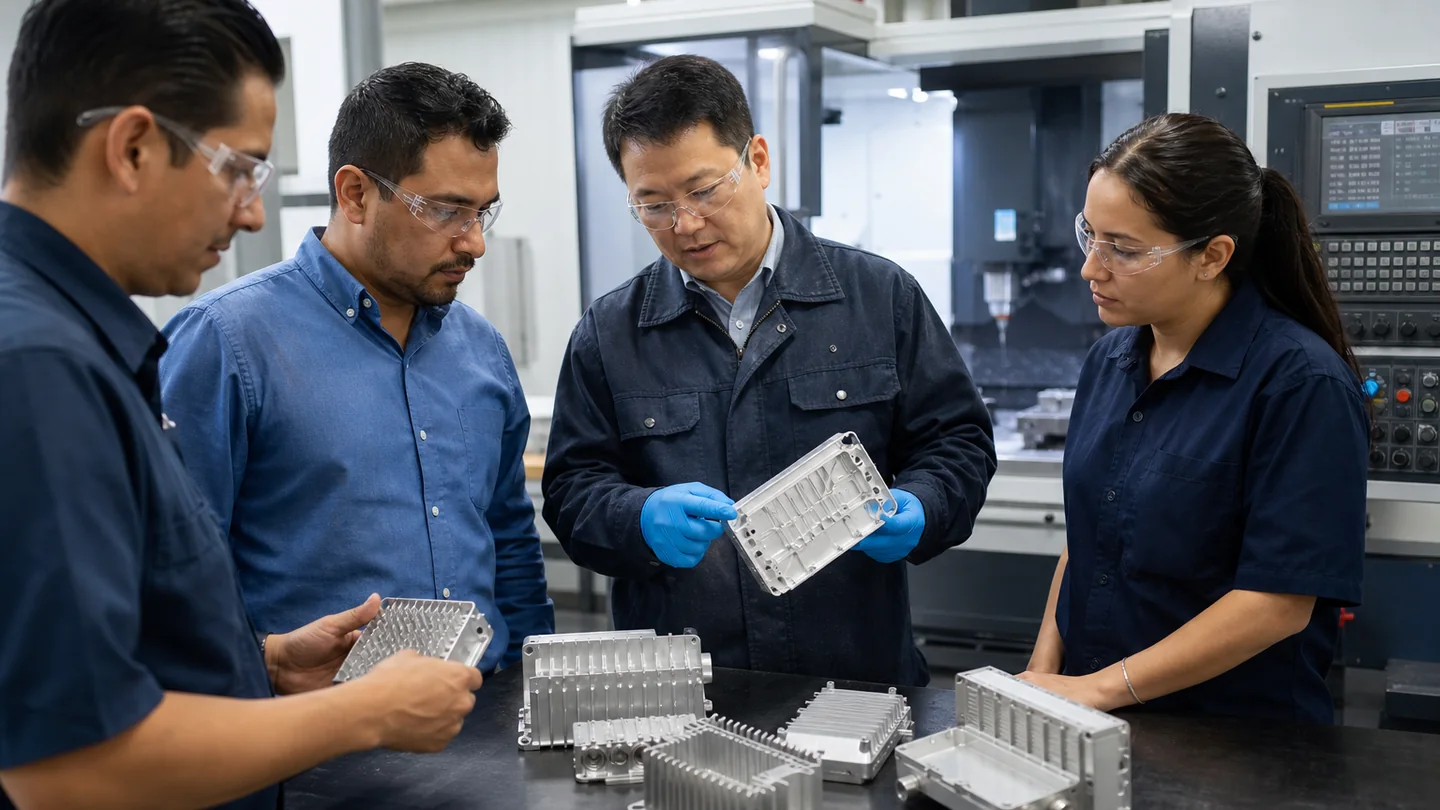
A drill tap center for aluminum housings should support the high number of holes, threads and milled interfaces common to covers, cases and enclosures. Fast tool changes can help, but reliable production depends on casting variation, stable datums, burr control, chip evacuation and a spindle matched to the actual cutters.
Define the incoming housing
State whether the blank is cast, forged or cut from stock. For castings, document draft, flash, expected location variation and the surfaces used for first location. A fixture must accommodate acceptable variation without distorting thin walls. Probing can confirm position, but cannot correct an unstable or incorrectly seated casting.
Build a feature and tool matrix
- List every drilled, reamed, bored and threaded hole with depth and tolerance.
- Identify sealing faces, bearing seats and datum pads.
- Record cutters, holders, gauge lengths and coolant delivery.
- Mark features that need a second orientation or rotary fixture.
- Include deburring and washing requirements in the process route.
Control aluminum chips at the source
Aluminum chips can pack into deep pockets and cling to wet surfaces. Choose cutting conditions and tool geometry for the alloy and operation, then check nozzle access and through-tool delivery where needed. The tank, screens and conveyor should be suitable for the expected chip volume. Fixture cleaning must protect locating points between cycles.
Keep speed in context
A high spindle-speed rating does not define the best cutting condition. Tool diameter, balance, runout, material, holder and available power all matter. Larger face-milling or roughing operations may set a different requirement from small drills. Review the whole tool list before selecting the spindle configuration.
Inspect the relationships that matter
Use a sample that includes a sealing face, located bore or hole pattern relevant to the drawing. Define datum setup, temperature and inspection method. If multiple fixtures or orientations are used, include the relationship across that transfer in acceptance.
CNC Tech can review an aluminum-housing process from the drawing, casting information, fixture concept and volume. The goal is a stable cell, not simply the shortest dry cycle.
Aluminum-housing references: examine the T7S machine configuration and the related electronic-hardware solution.