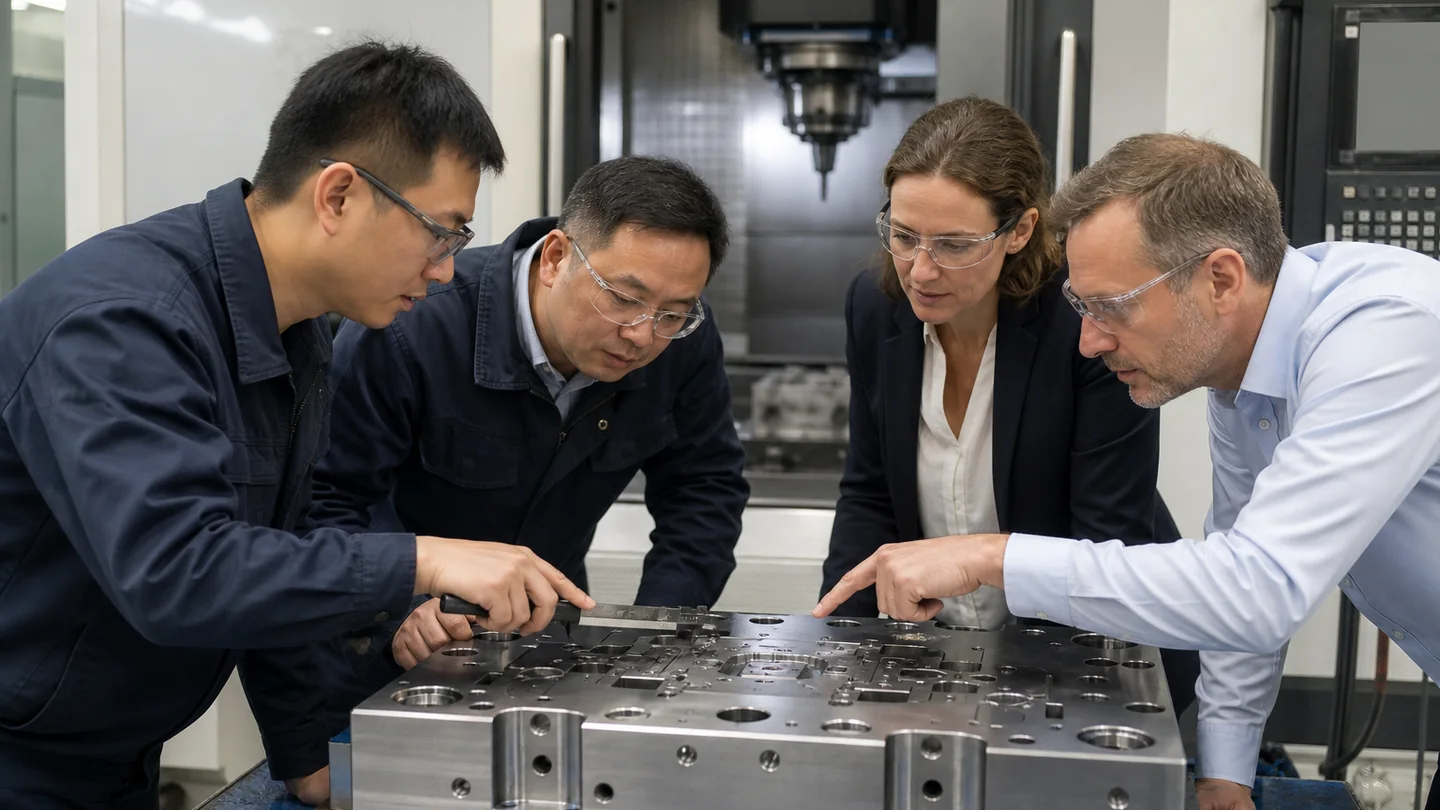
A gantry machining center for molds should be selected from the complete mold process, not from table size alone. Large blanks may require demanding roughing, while the same job can end with long fine-finishing cycles and deep-cavity tools. The machine, heads, tooling and measurement plan must support both stages without creating avoidable setups.
Map the mold from stock to finished surfaces
Record blank dimensions and mass, cavity depth, minimum radii, shutoff surfaces, insert locations and access angles. Add the fixture and clamping height. A tool-reach study will show whether a vertical head is enough, an angled attachment is useful, or a five-axis head materially shortens tools and reduces setups.
Separate removal capacity from finishing control
Roughing emphasizes torque, structure, chip evacuation and stable workholding. Finishing emphasizes spindle condition, tool runout, thermal behavior, motion quality and a consistent stock allowance. Asking for one headline specification to represent both duties hides the tradeoff. Use a roughing operation and a critical surface as two separate proof points.
- Agree on stock condition and the amount removed before the sample begins.
- Specify the actual holder, tool reach and machining direction.
- Record warm-up, coolant and ambient conditions.
- Define surface and dimensional inspection methods before cutting.
- Keep the test program and result as a commissioning reference.
Plan for long-cycle stability
A mold may remain on the machine through changing shop temperatures and spindle loads. Decide when probing occurs, how offsets are corrected and which features must be measured at a stable condition. Thermal compensation can help, but it does not replace controlled warm-up, machine maintenance and a documented inspection sequence.
Check the work around the cut
Chip pockets, graphite or abrasive materials, coolant filtration and cleaning access affect reliability and surface protection. Also review tool magazine capacity, tool-life control and recovery from a stopped finishing program. A machine that cuts a sample successfully still needs a practical route through the full production cycle.
For an application review, provide CNC Tech with the mold model, blank data, material, target surfaces and existing CAM approach. The resulting proposal should explain the chosen gantry layout and process limits in terms of those parts.
Mold-production context: connect this machine review with the mold-manufacturing solution and mold application case.